6-Month Open Enrollment Timeline: A Smarter Employee Benefits Strategy for Employers
Most employers don’t struggle with their benefits because of a lack of options.
They struggle because they start too late.
By the time open enrollment arrives, decisions feel rushed, costs feel fixed, and there’s little room to make meaningful changes. What should be a strategic process becomes reactive.
But the reality is this:
👉 A strong employee benefits strategy isn’t built at renewal—it’s built in the months leading up to it.
If you haven’t already, it’s worth taking a step back and reviewing how your current approach aligns with your long-term goals. A more proactive strategy can make a measurable difference in both cost and employee experience.
Why Mid-Year Is Critical for Benefits Planning
By May or June, employers already have access to valuable insights:
- Claims data is beginning to show trends
- Employees are actively using their benefits
- Questions and confusion points are becoming clear
These early indicators provide an opportunity to make adjustments before renewal pressures set in.
According to the Kaiser Family Foundation (KFF Employer Health Benefits Survey), employer-sponsored health insurance premiums continue to rise year over year—making early planning more important than ever.
Instead of reacting to increases, employers who review their benefits mid-year are in a stronger position to manage costs and improve outcomes.
For additional tools and insights, you can explore our resource library here:
👉 https://benaxisinc.com/resources/
The Problem with Traditional Open Enrollment Planning
Many organizations follow a compressed timeline that focuses only on the final 1–3 months before open enrollment.
During that period:
- Renewal rates are already determined
- Plan options are limited
- Employee communication is rushed
This approach leaves little room for strategic decision-making.
A more effective approach is to extend the planning window—starting at least six months before renewal.
The 6-Month Open Enrollment Timeline
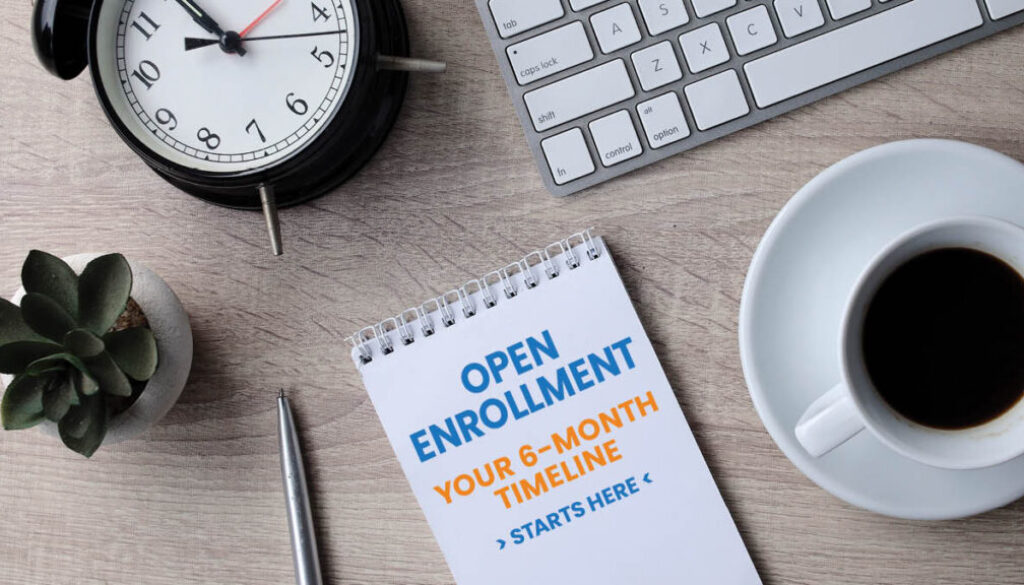
To help employers take a more proactive approach, we’ve developed a structured 6-month open enrollment timeline that aligns planning, strategy, and execution.
6 Months Before Renewal (May–June) – Review & Identify
This is where the most important work begins.
- Analyze claims data and identify cost drivers
- Review employee utilization patterns
- Identify gaps in understanding or engagement
- Gather feedback from HR and leadership
👉 At this stage, you’re identifying trends—not making final decisions.
4–5 Months Before (June–July) – Strategy & Planning
With initial insights in place, the focus shifts to strategy.
- Review funding options (fully insured, level-funded, self-funded)
- Explore cost control opportunities
- Evaluate potential plan design changes
- Begin discussions with your benefits consultant
This stage sets the direction for the rest of the process.
3 Months Before (August–September) – Evaluate & Compare
This is where options are reviewed in detail.
- Analyze renewal projections
- Benchmark against market options
- Compare alternative plans or carriers
- Narrow down plan selections
👉 This is often where employers uncover opportunities they wouldn’t have seen with a shorter timeline.
2 Months Before (September–October) – Finalize Decisions
With strategy defined, decisions can be finalized.
- Confirm benefit selections
- Complete compliance checks (ACA, ERISA, COBRA)
- Begin building enrollment materials
1 Month Before (October–November) – Communicate & Educate
Clear communication is critical to the success of any benefits program.
- Distribute benefit materials
- Host employee meetings or webinars
- Provide guidance on plan options
When employees understand their benefits, they’re more likely to use them effectively.
Final Month (November–December) – Enroll & Execute
The final step is execution.
- Complete open enrollment
- Ensure systems are functioning properly
- Submit final selections to carriers
At this point, the process should feel organized—not rushed.
Why a 6-Month Timeline Improves Outcomes
Taking a structured, long-term approach allows employers to:
- Make more informed decisions
- Reduce last-minute pressure
- Improve employee engagement
- Better manage long-term costs
It also reflects a more consultative, year-round approach to benefits planning—rather than a one-time event.
Download the 6-Month Open Enrollment Timeline
To simplify this process, we’ve created a 6-Month Open Enrollment Timeline you can use as a reference throughout the year.
Download the timeline to:
- Stay on track with key deadlines
- Plan internal discussions more effectively
- Improve your overall benefits strategy
Final Thoughts
Most benefits challenges don’t start at renewal.
They start months earlier—when trends begin to emerge and opportunities to adjust are often overlooked.
Mid-year is your opportunity to take a more proactive approach and position your organization for better outcomes.